Monday, 3 August 2015

Nakusp and AT War

Arrived Friday 24th of July to a dry (as in dusty) town on the Arrow Lakes in BC.  The weather was cool and rainy, and a full day of on and off again showers cut the dust, but was not enough to drop the campfire ban.

Although the town is smallish, pop. 1,500, it seems to have a nice mix of shops and services, and there were posters all over the place advertising the mideaval demo we were doing as part of the SCA event. 

The event itself went well, and the stroll through town in costume helped to build a positive buzz.


The event went smooth, very smooth considering that it was the first time at that site, as well as having a portion of the event open to the public.


The weather was hot, the shade was minimal and the people took it well, and had fun anyway.

Saturday, 20 June 2015

New camera

So I have finally gotten a nice camera to replace the one stolen in Peru.
It is a Pentax K-50, and it will be a very long time before I figure out all the bells and whistles on it.

But, here is a picture of my dad and a neighbour at a backyard BBQ.  I do love how a cloudy day softens shadows and lends itself to informal portraiture.

More pics later this summer as I get used to the camera.

Sunday, 14 June 2015

Why travel?

I recently read a post on Traveling.

The person writing it was much younger than me, and their outlook on life was very different because of it.  traveling gave him/her a different perspective and linked him/her into the traveling community.  Going back to mainstream after one year of travel would be as major a change for a lot of people as one year of military service or another life changing event.

As an older person, traveling did not affect me as deeply.  More, core values have not changed, and the way I look at others is still the same, albeit from a slightly different angle.  If anything traveling re-affirmed that underneath all the differences of language, culture and clothing, all of us in the Americas are far more alike than we are different.

Being poor sucks.  Being wanted lifts you up.  Needing ask for help when you are used to fending for yourself is a mix of humiliating, humbling, frustrating and depressing things.  Helping a friend when they are stuck down a hole is beyond rewarding, it is life affirming.  Helping a stranger, even with something trivial connects and lifts all.  Being needlessly mean sucks the life out of you and those around you.

All of that and more is brought home into your heart when you travel, and whether you assimilate this on the road or after does not matter.

Whether you travel across the globe or across the street does not matter.

It is the mind set you travel with, and the new angle of looking at the same places and people when you return that matters.

If you fail to see others living, and how they can be happy while having very little and empty inside while having plenty, you have failed in Traveling and just might be failing at Life.

I gave up a lot of material things to travel, and would do it again in a heartbeat.

What I am is not what I own or what I can buy.

It is who I connect with and who I love that define me more than anything else.

The hardest part of Traveling is letting go of connections, never knowing if they will be re-newed, and always being willing to make new ones, knowing how fragile they can be.

Friday, 13 March 2015

Back in Canada

Last time I returned, I wrote about the things I had missed, and the little things that returning meant to me.

This year, those things applied, but perhaps not with quite as much force.  I spent a fair amount of time at the end of my trip in Cusco Peru, not doing much, just hanging out, keeping spending low and waiting for my flight home to roll around.

I tried to spend some time walking around in the city away from the tourist zones, but ended up with a mild head cold and so did very little.  When you are not really used to the elevation, 7,200 feet does take a lot of stamina out of you.  On the other hand, even though I had a cold, when I got to Vancouver, I had a surprising amount of stamina.

The number 1 thing I brought away in the difference between Canada and Peru was what you do not see from the front.

In Peru, for the majority of the buildings, if you could not see it from the front, the walls were not finished or painted.  To my eyes, it gave a lot of the city a half-finished look.  Add in how much was brick and adobe, it left the overwhelming colour of the cities as being red-brown.  Add in the lack of green in terms of front yards and easements, it turns everything into industrial harsh.  Viewed from above, there are quite a few trees and green spots hidden away in courtyards and walled off areas which make for pleasant breaks when you find them, but from the outside reduce the atmosphere of the cities.

And as in most of the other countries, trash was very much a not-in-my-yard affair.  The empty lot next door could be knee deep in trash, but as long as your own yard was clean, that was all that counted.  This seemed to extend to roads and railways as well, in that within towns, the ditches were kept clean, but as soon as the town limit was reached, it was crystal clear because of the amount of trash that piled up on the edges.

In the coastal areas of Peru, they do make large efforts to green up parks and other areas.  All the settlements I noticed were there because of ease of access to water.  The entire coast has so little rain fall that if there is no river, there is no way to live, and they really appreciate the green of grass and trees.  Walking across lawn gets you dirty looks, sitting on the small patches of grass in a public park will soon have a peace officer making you move off it.  But due to the lack of rain, the overall feel of the coast was for light blowing sand and a lack of green.  Very much not my cup of tea.

Canada is the same as ever, and the West Coast will always have views to lift my spirit.  Time to visit friends, make some food, and tell some stories.  I will not blog much during the coming months, but they should be busy ones, and so the time will fly by.

Comments on where to go next are welcome this time, I am contemplating a run to Spain, Morocco and Crete.  Opinions?

Friday, 27 February 2015

Maras Moray

It was a interesting trip.  It started fine, I went to the tour agency and was met by a guide for the two block walk to the roundezvous spot.
After joining the 10 or so milling tourists, most of whom appeared fluent in Spanish, I was placed beside two Latino women who were going on the same tour.
Another guide came along and lead is off to a small bus.  On board and off we went.  Five minutes into the ride I found out I was on the wrong bus.  The guide on the bus made a quick call and informed me I would be let off at a turn out, and a taxi would be along soon to take me to my real shuttle.
Ten minutes or so later a taxi with one of the tour people with less English than I have Spanish picked me up, and off we went following the bus I just got off of.
I had wondered while waiting if the two Latin ladies were also on the wrong bus, and yes they were.  We were at least another ten minutes driving to get to the spot they were dropped off at, then we turned around to catch up with the shuttle we were supposed to be on.
There were five of us in a taxi designed for five.  Crowded but not bad.
Then we got joined by another guide who ended up sitting in a lap.
Fifteen minutes riding in a taxi, listening to three people talking rapid fire Spanish into cell phones, we pulled over to a stop, one of the tour agents got out and paid the taxi driver, and we were off to catch the shuttle with only five in the taxi.
We got to the town where the shuttle was supposed to be waiting for us, and there was no shuttle.
Two more phone calls and we got accurate directions to the shuttle.
Try to load everyone on the shuttle, and lo and behold there are now three too many people to fit on the shuttle.
One who had been picked up on route got let off twenty miles early, and a late joiner ended up in the aisle along with the actual tour guide.
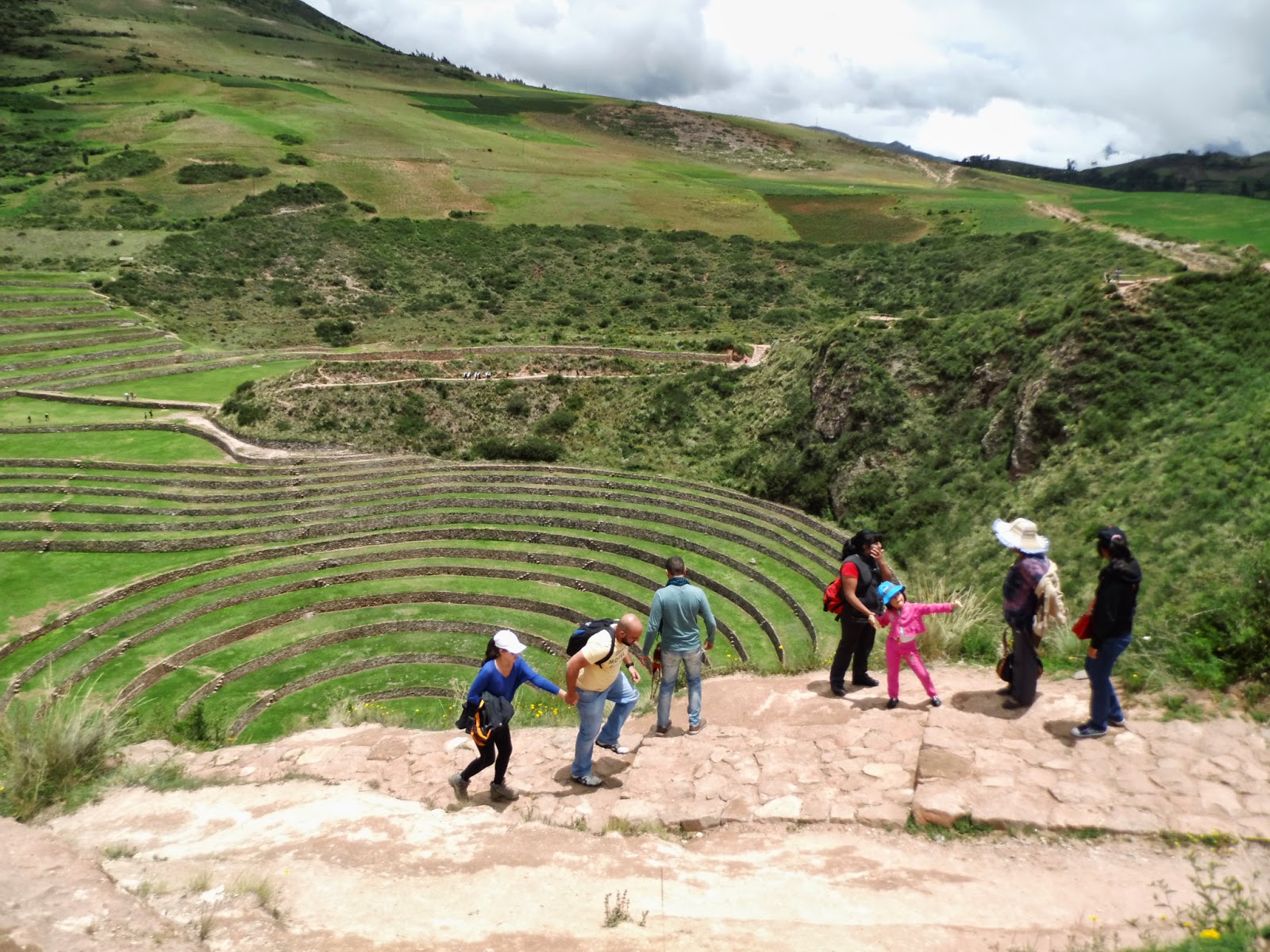
So, with an hour delay, we were off to the town of Maras and the nearby Incan site called Moray.

I could not find a reference for when the site for started.  It is Incan, without doubt in style of stone work and irrigation.  There is a lot of speculation on the actual use of the site, but the majority of people think it is the world's oldest agricultural research station.

Between the location, microclimate and stone work, there is a fifteen degree difference in temperature between the topmost, coldest terrace and the bottom one.
The stones in the lower terraces act as heat sinks and although the temperatures are fairly even from top to bottom during the day, at night, the difference appears.  The narrower the terrace, the more the stone influences the temperature.
There has been much speculation on how the Incas managed to create the vast diversity  of crops, with over 3,000 varieties of potato alone, but it must be rooted in research such as would be possible at Moray.


There was an extremely wet year, and extensive damage was done to the east terracing, with wooden shoring being put in place until funds are available for reconstruction.

The site goes a long way towards showing the strength of the Incas.  They were masters at using natural features for building and agriculture, including irrigation.  One of their greatest influences on modern times though was their dedication to agriculture and the diversity of crops this has brought us.  They experimented to find the best fertilizers, and used a variety depending on both crop and climate.

All in all, a fascinating look into how, in part, they achieved greatness.


Monday, 23 February 2015

Machu Picchu

This is going to be a little more whimsical than usual.

There are many things about the ancient site which are amazing, and the most amazing is the fact that it was built at all.  It is a four day trek from the nearest settlement and is perched on a mountaintop.

Humans are a curious bunch, and I can easily see a hunter or explorer finding the place.  But then whatever possessed them to actually build a city there.  Was it something along the of 'Cousin Bob is always asking to borrow my mattock.  If I move here, the lazy bastard will not come this far to borrow it.'. Or was it more for the view?

Anyway I see the place slowly grow into a hamlet or small town.  Then one day the king says 'I need to get away for a little bit.'

And Cousin Bob then says 'Hey, my cousin Tom has a place Nobody else goes near'

And the next thing Tom knows his hideaway is now a Royal Getaway.

Damn Royals.


Cousin Bob

And wouldn't you love to be the guy putting in the lowest level of terracing while Cousin Bob held the rope?


Thursday, 19 February 2015

Lipon Peru

Just down the valley from Cusco, Lipon is a small town with an agricultural base.  The archeologists have dated the settelments in the area as far back as 750AD, with continous habitation from 1100AD, making the Cusco Vally the longest continually inhabited place in the Americas.

The area of Lipon has an elevation of 3,200m, and for the most part is fairly dry.  All of the settlements in the area have some sort of irrigation, the creeks draining the mountains surrounding the valley and the Cusco river running down the middle supply a fair amopunt of water, but going by the efforts of early people, irrigation was the only way to get a decent crop from off of the land.  No pumps were used of course, so it was all done by rock lined channels carefully using the contours and natural features of the land to give terraced fields trickles of water for feeding the crops.


The amount of rock used in this terracing is immense, the channels for the water mostly run on the right side of the image.


The volume of water is not immense, but it is used multiple times, flowing from one terrace down to the next.


There are two areas bracketing the mouth of the valley with remains of habitation.


The fact that the irrigation system still functions quite well after over 1,000 years is amazing.  To my eyes there are traces of how water was diverted at the top of the slope to cover yet another field, one above and to the right of the top image.  The broken area with no terracing could have been left to allow the water to drain into the lower terracing.

No one has done an estimate of the amount of hours of labour that went into creating this field system, but it speaks to me of an area that valued its arable land to an extreme, that such a large amount of labour for a relatively small amount of land.  I did not have time to search the surrounding land, but even the valley way below has many fields which could have been irrigated at a much lower labour cost.

The in accesability of the valley may have an indication as to why it was used, the long winding road would discourage anyone from making their way up, and the valley itself is hidden except from the peaks, making it very hard to attack and easy to defend.

An interesting place, and truly lovely spot for a picnic.